Introduction
Land acquisition by the state for public purposes is one of the most contentious areas of Indian law, touching as it does upon the competing interests of development, property rights, livelihood, and social justice. The power of eminent domain — the inherent power of the state to compulsorily acquire private property for public use — has been exercised extensively in India to acquire land for infrastructure projects, industrial development, special economic zones, and urban expansion. However, this power has also been widely criticized for being exercised in an arbitrary, opaque, and often exploitative manner, leading to the displacement of millions of people, particularly the rural poor, tribals, and other marginalized communities.
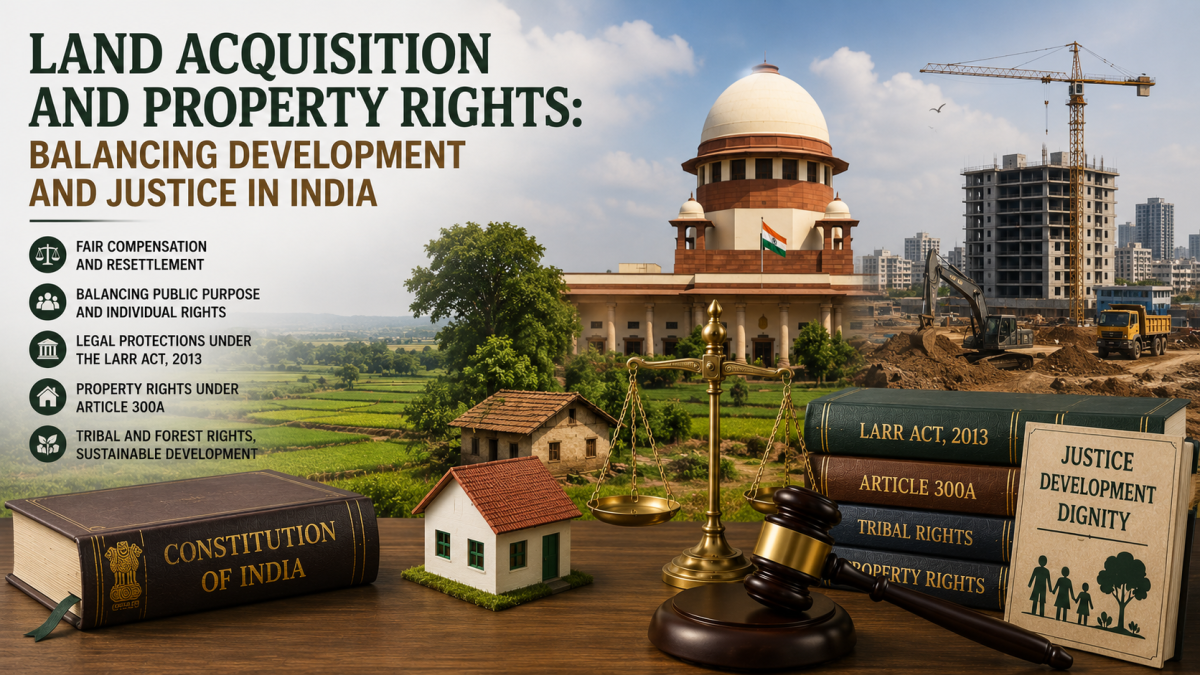
The enactment of the Right to Fair Compensation and Transparency in Land Acquisition, Rehabilitation and Resettlement Act, 2013 (LARR Act) represented a significant reform of India’s land acquisition framework, introducing mandatory consent requirements, enhanced compensation, and comprehensive rehabilitation and resettlement provisions. However, the implementation of the LARR Act and its interpretation by courts have continued to generate significant legal controversy. This article examines the legal framework and key judicial developments on land acquisition and property rights in India.
Constitutional Framework: The Right to Property
The right to property has had a chequered constitutional history in India. Originally guaranteed as a fundamental right under Article 19(1)(f) and Article 31, the right to property was progressively curtailed through a series of constitutional amendments that protected zamindari abolition laws and land reform measures from judicial challenge. The 44th Constitutional Amendment in 1978 deleted the right to property from the list of fundamental rights and relegated it to a mere constitutional right under Article 300A, which provides that no person shall be deprived of property save by authority of law.
The Supreme Court has interpreted Article 300A to require that the law authorizing deprivation of property must be a valid law, that it must serve a public purpose, and that it must provide for just and fair compensation. The Court has held that the right to property, though no longer a fundamental right, is a constitutional right and a human right that cannot be taken away without due process and fair compensation.
The LARR Act, 2013: A New Framework
The Right to Fair Compensation and Transparency in Land Acquisition, Rehabilitation and Resettlement Act, 2013 replaced the colonial-era Land Acquisition Act of 1894. The LARR Act introduced several progressive features, including a requirement for social impact assessment, mandatory consent of 70-80% of affected families for acquisition for private companies and public-private partnerships, enhanced compensation at up to four times the market value in rural areas, and comprehensive rehabilitation and resettlement entitlements for displaced persons and families.
However, the LARR Act has also been criticized for creating barriers to land acquisition for legitimate public purposes and for the complexity of its consent and social impact assessment requirements. Several State Governments have enacted their own land acquisition laws that provide for less stringent consent and compensation requirements than the LARR Act, and the constitutional validity of these State laws has been challenged before the courts.
Displacement and Rehabilitation: The Rights of Project-Affected Persons
The displacement of communities due to infrastructure and development projects has been one of the most pressing social justice issues in India. The Supreme Court in N.D. Jayal v. Union of India (2004) held that rehabilitation of persons displaced by large dam projects is a fundamental right flowing from Article 21, and that the state cannot deprive persons of their land, livelihood, and home without ensuring adequate rehabilitation. The Court also emphasized that the rights of tribals and forest-dwelling communities must be given special protection in the context of land acquisition for development projects.
The Forest Rights Act, 2006 recognized the historical injustice done to forest-dwelling communities and granted them rights over the forest land they have traditionally occupied and used. The Supreme Court in Wildlife First v. Ministry of Forest and Environment (2019) ordered the eviction of millions of forest dwellers whose claims under the Forest Rights Act had been rejected, causing widespread alarm. The order was subsequently modified following protests, and the Court directed States to ensure due process before evicting forest dwellers.
Urban Land and Housing Rights
The right to shelter has been recognized by the Supreme Court as a component of the right to life under Article 21. In Olga Tellis v. Bombay Municipal Corporation (1985), the Court held that pavement dwellers have a right to be heard before they are evicted and that the right to livelihood flows from the right to life. This judgment laid the foundation for the protection of housing rights of urban poor in India and has been invoked in numerous subsequent cases challenging slum demolitions and forced evictions.
Courts have generally held that mass evictions of slum dwellers and urban poor without prior notice, adequate alternative accommodation, and due process violate constitutional rights. However, courts have also recognized that urban governance requires the regularization of encroachments and the enforcement of land use regulations, and have sought to balance these competing imperatives through orders for in-situ rehabilitation and time-bound resettlement of affected communities.
Compulsory Acquisition: Market Value and Just Compensation
The question of what constitutes just and fair compensation for compulsorily acquired land has been extensively litigated in Indian courts. Courts have held that market value is the primary basis for determining compensation, but that the determination must take into account all relevant factors including the potential use of the land, the development in the neighbourhood, and the loss of access to livelihood. The Supreme Court has also addressed the issue of solatium — the additional amount paid over and above market value to acknowledge the hardship caused by compulsory acquisition — and has consistently upheld the right of landowners to solatium and interest on delayed payment of compensation.
Conclusion
Land acquisition law in India stands at the intersection of development, social justice, and constitutional rights. While the state’s power of eminent domain is necessary for public purposes, its exercise must be accompanied by meaningful consent, fair compensation, and genuine rehabilitation of affected communities. The legal framework under the LARR Act, though imperfect in its implementation, represents a significant step towards a more humane and equitable approach to land acquisition. Courts will continue to play a vital role in enforcing the rights of project-affected persons and in ensuring that the developmental imperatives of the state do not override the constitutional rights of the most vulnerable sections of Indian society.