Introduction
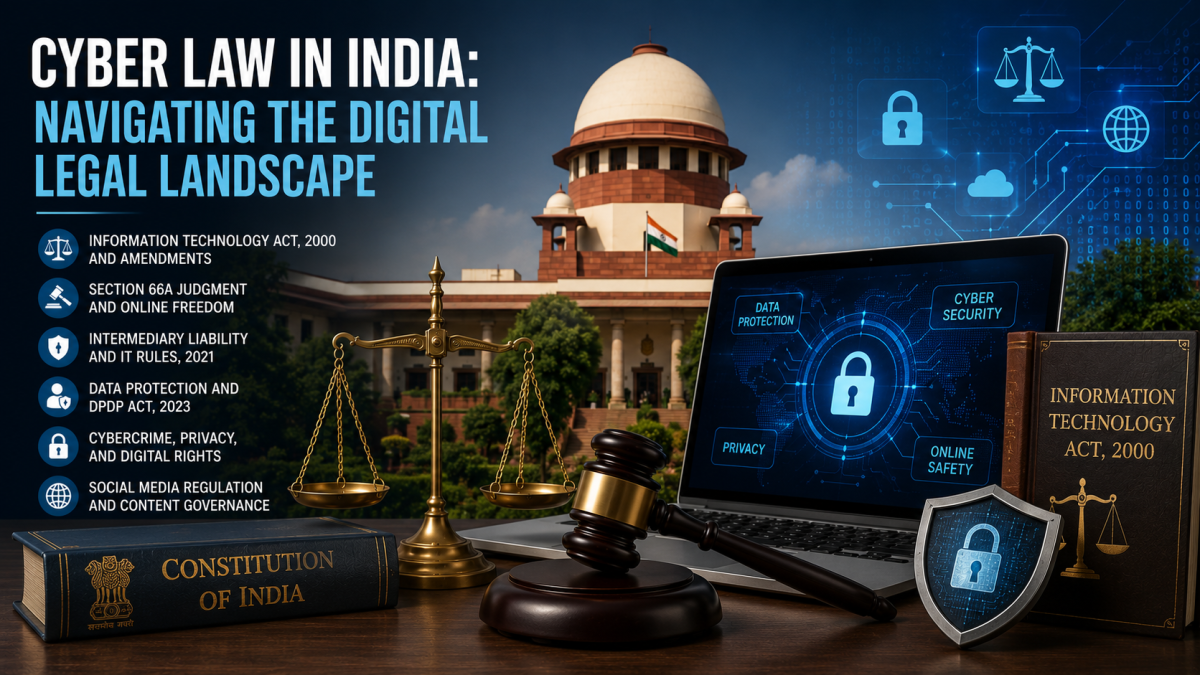
The rapid expansion of digital technology and internet penetration in India has given rise to a complex set of legal challenges that existing laws were ill-equipped to address. The Information Technology Act, 2000 (IT Act) was India’s first attempt to provide a legal framework for electronic commerce, digital signatures, and cyber offences. Since its enactment, the Act has been amended and supplemented by rules and regulations to address emerging issues such as data protection, online intermediary liability, cybercrime, and digital governance.
Indian courts have been at the forefront of developing cyber jurisprudence, interpreting the IT Act and related laws in the context of constitutional guarantees of free speech, privacy, and due process. The judiciary has also been called upon to balance the legitimate interests of the state in regulating cyberspace with the rights of individuals to expression, privacy, and economic participation in the digital economy. This article examines the evolving legal landscape of cyber law in India, with a focus on key legislation, judicial decisions, and emerging challenges.
The Information Technology Act, 2000: Framework and Amendments
The IT Act, 2000 provides for the legal recognition of electronic records and digital signatures, establishes the framework for electronic governance and commerce, and defines a range of cyber offences including unauthorized access, hacking, data theft, and publishing of obscene material in electronic form. The Act was substantially amended in 2008 to address new categories of cyber offences including identity theft, cyberterrorism, and the use of communication devices for offensive messages.
One of the most controversial provisions of the IT Act, as amended in 2008, was Section 66A, which criminalized online communication that was “grossly offensive” or caused “annoyance, inconvenience, danger, obstruction, insult, injury, criminal intimidation, enmity, hatred or ill will.” This provision was widely criticized for being vague, overbroad, and inconsistent with constitutional guarantees of free speech, and was struck down by the Supreme Court in Shreya Singhal v. Union of India (2015) on the grounds that it failed to meet the constitutional standards for reasonable restrictions on free speech.
Intermediary Liability: The Safe Harbour Debate
Section 79 of the IT Act provides a safe harbour from liability for online intermediaries — such as social media platforms, search engines, and internet service providers — in respect of content hosted or transmitted by third parties, provided the intermediary complies with due diligence requirements and removes infringing content upon receiving actual knowledge of its illegality. The scope of this safe harbour and the due diligence obligations of intermediaries have been the subject of extensive litigation.
The Information Technology (Intermediary Guidelines and Digital Media Ethics Code) Rules, 2021 introduced significant new obligations for large social media intermediaries, including requirements for the appointment of compliance officers, the establishment of grievance redressal mechanisms, and the traceability of the originator of messages on encrypted platforms. These rules have been challenged before various High Courts on grounds of free speech, privacy, and the right to encryption, and the litigation continues to evolve.
Data Protection: The Digital Personal Data Protection Act, 2023
Following the Supreme Court’s recognition of privacy as a fundamental right in Justice K.S. Puttaswamy v. Union of India (2017), there was a growing demand for a comprehensive data protection law in India. The Digital Personal Data Protection Act, 2023 (DPDP Act) was enacted to give effect to the fundamental right to informational privacy and to regulate the processing of personal data by government and private entities.
The DPDP Act establishes principles of lawful purpose, collection limitation, data minimization, accuracy, storage limitation, and accountability for data processing. It also provides data principals (individuals) with rights to access information, correction, erasure, and redressal of grievances. A Data Protection Board has been established for the adjudication of complaints and the imposition of penalties for non-compliance. However, the Act has been criticized for its broad exemptions for government entities and the absence of robust provisions for data localization and cross-border data transfers.
Cybercrime: Investigation and Prosecution Challenges
The investigation and prosecution of cybercrime in India faces significant challenges, including the trans-national nature of cyber offences, the technical complexity of digital evidence, the lack of specialized training among law enforcement agencies, and the absence of effective international cooperation frameworks. The IT Act and the provisions of the Indian Penal Code (and the Bharatiya Nyaya Sanhita) that deal with cybercrime have been criticized for not keeping pace with the rapidly evolving threat landscape.
Courts have been called upon to address complex questions of evidence in cybercrime cases, including the admissibility and authentication of electronic records, the territorial jurisdiction of Indian courts over offences committed from foreign countries, and the rights of accused persons in cybercrime investigations. The Supreme Court and High Courts have emphasized the need for digital forensic standards and the importance of protecting the integrity of electronic evidence to ensure fair trials.
Digital Media Regulation
The regulation of digital news media and online content platforms has been a contentious area of policy and litigation in India. The Information Technology (Intermediary Guidelines and Digital Media Ethics Code) Rules, 2021 extended regulatory oversight to digital news publishers and online curated content providers (OTT platforms), requiring them to observe a code of ethics and to establish a grievance redressal mechanism. Several digital news publishers and OTT platforms challenged these regulations before the High Courts, arguing that they impose disproportionate restrictions on freedom of the press and expression.
Courts have been called upon to balance the legitimate regulatory interests of the state in preventing the spread of misinformation, hate speech, and harmful content with the constitutional guarantee of press freedom. The evolving legal framework for digital media regulation will have significant implications for the future of journalism, free expression, and the digital public sphere in India.
Conclusion
Cyber law in India is a rapidly evolving field that presents both opportunities and challenges for the legal system. The enactment of the Digital Personal Data Protection Act, the ongoing regulation of social media and digital content, and the development of India’s cybersecurity framework represent significant steps towards a more comprehensive legal infrastructure for the digital age. However, the effective protection of rights in cyberspace requires not only robust legislation but also judicial literacy in digital technologies, specialized law enforcement capacity, and international cooperation. As India aspires to become a leading digital economy, the development of a rights-respecting and innovation-friendly cyber law framework will be one of the defining legal challenges of the coming decades.