Introduction
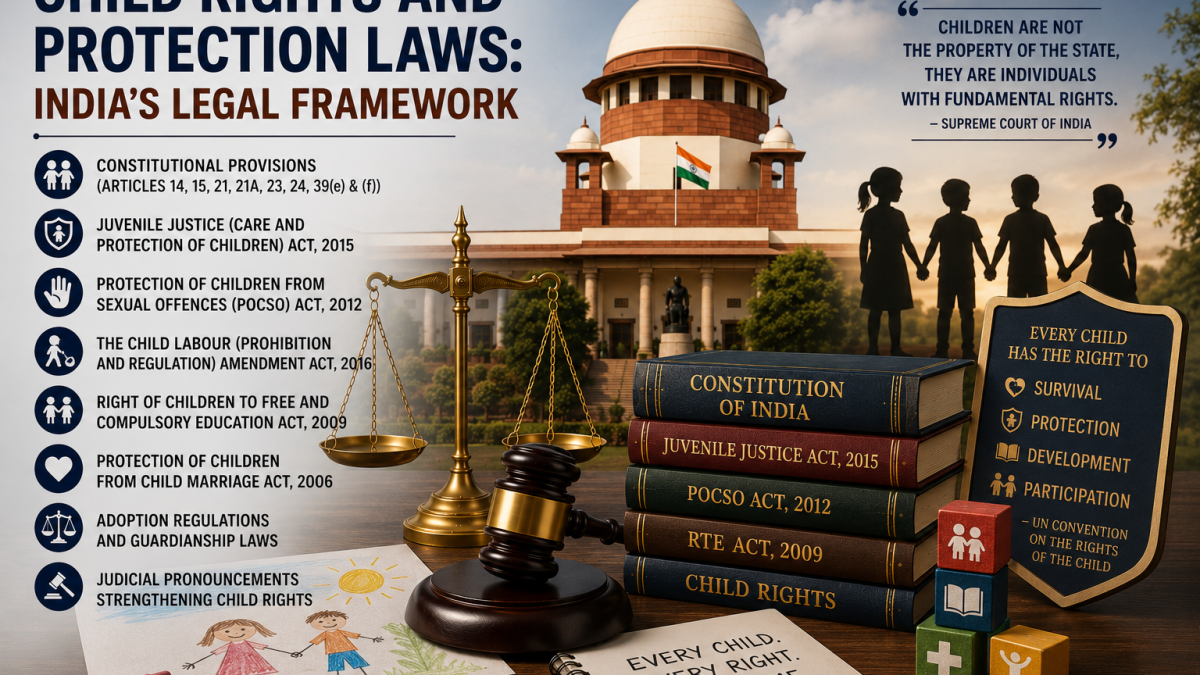
Children constitute the most vulnerable section of society, and their protection through a robust legal framework is both a constitutional imperative and an international obligation. India has enacted a comprehensive body of legislation to safeguard the rights and welfare of children, including the Protection of Children from Sexual Offences Act (POCSO), the Juvenile Justice (Care and Protection of Children) Act, and the Right to Education Act. Courts have played a pivotal role in interpreting and enforcing these laws, ensuring that children’s best interests remain the paramount consideration in all proceedings involving them.
India is also a signatory to the United Nations Convention on the Rights of the Child (UNCRC), which recognizes the rights of every child to survival, development, protection, and participation. The Supreme Court and High Courts have drawn upon the principles of the UNCRC in developing India’s child rights jurisprudence. This article examines the key legislation and judicial decisions that have shaped the protection of children’s rights in India.
The POCSO Act and Its Judicial Interpretation
The Protection of Children from Sexual Offences Act, 2012 (POCSO) is the primary legislation governing offences of sexual abuse against children. The Act defines a comprehensive range of sexual offences including penetrative and non-penetrative sexual assault, sexual harassment, and child pornography, and provides for stringent punishments including life imprisonment in cases of aggravated penetrative sexual assault. The Act also establishes a child-friendly procedure for the recording of evidence and mandates special courts for the trial of POCSO cases.
The Supreme Court and various High Courts have been called upon to interpret several provisions of the POCSO Act. In Libnus v. State of Goa (2021), the Supreme Court clarified that the offence of sexual assault under the POCSO Act requires physical contact involving skin-to-skin touching. The judgment attracted considerable criticism for its narrow interpretation and was subsequently reviewed. The Supreme Court in Attorney General of India v. Satish (2021) overturned the Bombay High Court’s controversial skin-to-skin contact ruling and affirmed a broader, purposive interpretation of sexual assault under POCSO.
Juvenile Justice: The Reformative Approach
The Juvenile Justice (Care and Protection of Children) Act, 2015 governs the treatment of children in conflict with the law and children in need of care and protection. The Act is premised on the principle that children who commit offences are primarily victims of their circumstances and must be rehabilitated rather than punished. The Act establishes Juvenile Justice Boards for the adjudication of offences by children below the age of 18 and Child Welfare Committees for the care and protection of vulnerable children.
One of the most significant and controversial provisions of the 2015 Act is Section 15, which permits the trial of children between the ages of 16 and 18 as adults if they are found to have committed heinous offences and the Juvenile Justice Board determines that they have the mental and physical capacity to commit such offences. This provision was introduced in the wake of public outcry following the Nirbhaya gang rape case, in which one of the accused was a juvenile. Courts have been called upon to ensure that the fundamental protections afforded to juveniles under international human rights law are not undermined by a punitive approach to juvenile justice.
Right to Education: Implementation and Challenges
The Right of Children to Free and Compulsory Education Act, 2009 (RTE Act) gives effect to Article 21A of the Constitution, which guarantees free and compulsory education to all children between the ages of 6 and 14. The Act requires the State to provide free education in a neighbourhood school and mandates private unaided schools to reserve 25% of their seats for children from economically weaker sections and disadvantaged groups.
The Supreme Court in Society for Unaided Private Schools of Rajasthan v. Union of India (2012) upheld the constitutional validity of the RTE Act and the 25% reservation requirement, holding that while private schools have the right to establish and administer educational institutions, this right is subject to regulatory control in the larger public interest of providing education to all children. Courts have also interpreted the RTE Act to prohibit corporal punishment, casteist discrimination, and the denial of admission to children without proof of age documents.
Child Labour: The Judicial Response
The Supreme Court in M.C. Mehta v. State of Tamil Nadu (1996) delivered a landmark judgment on child labour in hazardous industries, holding that child labour in violation of constitutional provisions amounted to a violation of Article 24 and Article 21. The Court directed the establishment of a Child Labour Rehabilitation-cum-Welfare Fund and ordered the payment of compensation for child workers in hazardous occupations. The judgment was instrumental in shaping India’s approach to child labour regulation and led to significant legislative reforms.
The Child Labour (Prohibition and Regulation) Amendment Act, 2016 extended the prohibition on child labour to all occupations and processes for children below the age of 14, with limited exceptions for family-based occupations and creative arts. The amended law also prohibits the employment of adolescents (14-18 years) in hazardous occupations.
Child Marriage: Legal Framework and Judicial Action
The Prohibition of Child Marriage Act, 2006 declares child marriages voidable at the option of the minor and provides for the punishment of persons who solemnize, promote, or permit child marriages. The Supreme Court and High Courts have been called upon to balance the enforcement of the child marriage prohibition law with the personal laws of various religious communities that may permit marriage below the legal age.
In Independent Thought v. Union of India (2017), the Supreme Court held that sexual intercourse by a man with his minor wife below the age of 18 constitutes rape under the Indian Penal Code, irrespective of the consent of the wife. The judgment closed a long-standing exception in the rape law that had shielded husbands from prosecution for marital rape of minor wives, and affirmed the paramountcy of the rights of the child over personal law traditions.
Conclusion
India’s legal framework for the protection of child rights has been significantly strengthened through progressive legislation and activist judicial decisions. However, the effective implementation of child protection laws remains a challenge, hampered by factors such as poverty, lack of awareness, overburdened courts, and inadequate child protection infrastructure. A sustained commitment by all branches of government, in partnership with civil society and communities, is essential to ensure that every child in India enjoys the rights and protections guaranteed by the Constitution and international human rights law.