Introduction
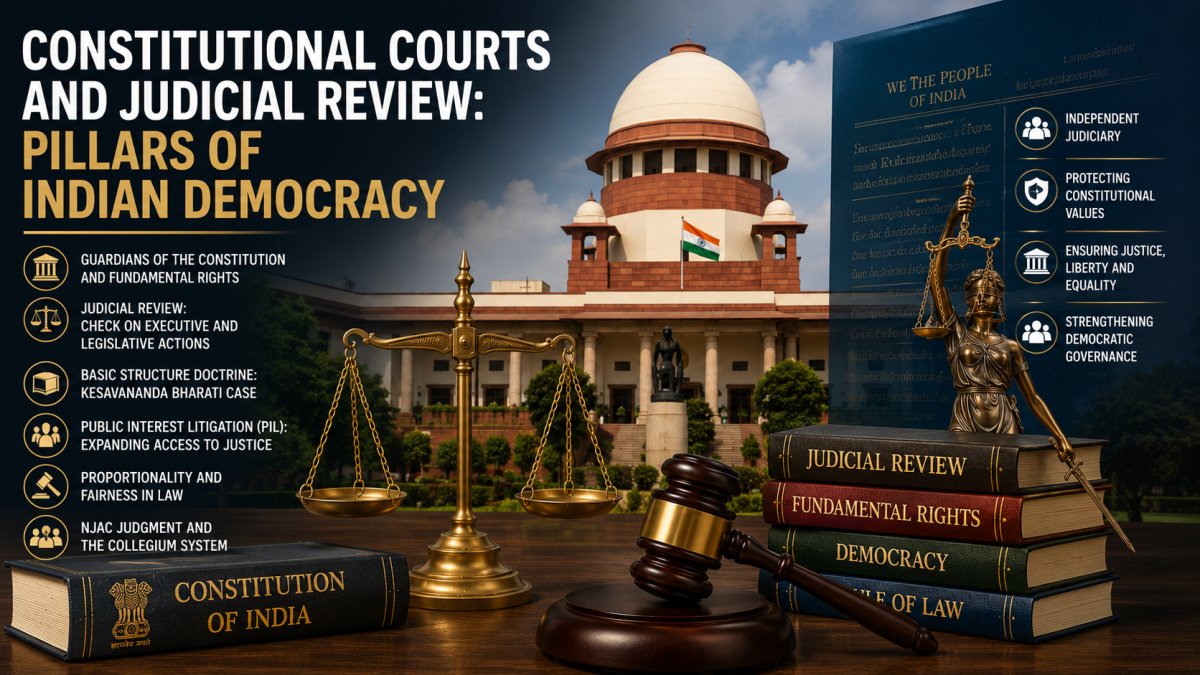
Judicial review — the power of courts to examine the constitutional validity of legislative and executive actions — is one of the foundational principles of the Indian constitutional order. The Supreme Court of India and the High Courts exercise the power of judicial review to ensure that no organ of the state transgresses the limits imposed by the Constitution. This power is not merely a procedural mechanism but a substantive guarantee that the rule of law prevails over the rule of men and that constitutional values are upheld even against the will of elected majorities.
The scope and exercise of judicial review in India has been shaped by decades of jurisprudence that has defined the boundaries between judicial activism and judicial restraint, between the legitimate interpretation of the Constitution and unwarranted intrusion into the domain of the executive and legislative branches. This article examines the doctrine of judicial review in India, its constitutional basis, key landmarks, and evolving contours.
Constitutional Basis of Judicial Review
The power of judicial review in India derives primarily from Articles 13, 32, and 226 of the Constitution. Article 13 declares that any law inconsistent with or in derogation of fundamental rights shall be void to the extent of such inconsistency. Article 32 grants every person the right to approach the Supreme Court for the enforcement of fundamental rights, and the Court is empowered to issue writs including habeas corpus, mandamus, prohibition, quo warranto, and certiorari for this purpose. Article 226 confers similar but broader powers on the High Courts.
The Supreme Court has consistently held that the power of judicial review is part of the basic structure of the Constitution and cannot be taken away or abridged by Parliament even through constitutional amendment. This principle was affirmed in L. Chandra Kumar v. Union of India (1997), where a seven-judge bench held that the power of the High Courts to review legislative and executive action under Articles 226 and 227 is an integral and essential feature of the Constitution and cannot be excluded by any law.
The Doctrine of Proportionality
In recent years, the Supreme Court has increasingly applied the doctrine of proportionality in reviewing state action that affects fundamental rights. Under this doctrine, a restriction on a fundamental right must be proportionate to the legitimate aim sought to be achieved, and the means chosen must be the least restrictive among the available options. The doctrine was comprehensively analyzed by the Supreme Court in Modern Dental College and Research Centre v. State of Madhya Pradesh (2016) and has since been applied in a range of contexts from business regulation to free speech restrictions.
The application of proportionality analysis marks a significant shift in Indian judicial review from the earlier reasonableness test, which was more deferential to the state, to a more rigorous and structured assessment that requires the state to justify its actions with greater precision. This development brings Indian constitutional jurisprudence closer to the standards applied by constitutional courts in Europe and other jurisdictions.
Public Interest Litigation: Democratizing Access to Justice
One of the most distinctive features of Indian judicial review is the institution of Public Interest Litigation (PIL), which allows any person acting in the public interest to approach the Supreme Court or High Court for the enforcement of rights of disadvantaged groups or the prevention of public injury. PIL has dramatically expanded the scope of judicial review in India, enabling courts to intervene in a vast range of matters from prison conditions and bonded labour to environmental pollution and electoral reforms.
The genesis of PIL can be traced to the decisions of Justice V.R. Krishna Iyer and Justice P.N. Bhagwati in the late 1970s and early 1980s, who relaxed the rule of locus standi to allow public-spirited individuals and organizations to file petitions on behalf of those who could not access the courts themselves. PIL has been instrumental in securing landmark judgments on issues such as the right to food, the right to shelter for the homeless, the rights of undertrial prisoners, and the protection of the environment.
Limits of Judicial Review: Policy Decisions and Legislative Wisdom
While the power of judicial review is broad, courts have consistently recognized that there are matters within the exclusive domain of the executive and legislative branches where judicial intervention would be inappropriate. Policy decisions, economic reforms, budgetary allocations, and matters of national security are generally regarded as non-justiciable on their merits, and courts will not substitute their judgment for that of the government on questions of policy wisdom.
The Supreme Court in Tata Cellular v. Union of India (1994) laid down the principles governing judicial review of government contracts and commercial decisions, holding that courts should not interfere with government decisions made in the exercise of executive discretion merely because they disagree with the wisdom of the decision. The Court’s role is confined to examining whether the decision was made lawfully, without violation of constitutional principles, and free from mala fides or irrelevant considerations.
Judicial Accountability and Collegium System
The independence of the judiciary in India is protected by constitutional provisions on the appointment, removal, and conditions of service of judges. The collegium system, evolved through a series of Supreme Court judgments known as the Three Judges Cases, gives the judiciary a dominant role in the appointment and transfer of judges, effectively removing executive control over judicial appointments. In Supreme Court Advocates-on-Record Association v. Union of India (2015), the Supreme Court struck down the 99th Constitutional Amendment and the National Judicial Appointments Commission Act as unconstitutional violations of the basic structure doctrine of judicial independence.
However, the collegium system itself has been criticized for its lack of transparency and accountability. The demand for a more open and consultative process of judicial appointments has grown in recent years, with calls for reforms that preserve judicial independence while ensuring greater transparency and diversity in the selection of judges.
Conclusion
Judicial review is the cornerstone of constitutionalism in India and a critical safeguard against the abuse of power. The Supreme Court and High Courts, through their power of judicial review, have been instrumental in upholding constitutional values, protecting fundamental rights, and ensuring the accountability of all organs of the state. As India’s democracy matures and new challenges emerge, the role of constitutional courts in maintaining the balance of power and preserving the rule of law will only become more important. The continued vitality of judicial review depends on the independence, impartiality, and accessibility of the judiciary, and on the commitment of all constitutional actors to the principles of the Constitution.