Introduction
The struggle for gender justice in India has been significantly shaped by judicial pronouncements that challenged patriarchal norms and expanded the rights of women under the Constitution. Indian courts have played a transformative role in addressing issues ranging from workplace harassment and matrimonial rights to inheritance and reproductive autonomy. These landmark judgments have not only given legal voice to millions of Indian women but have also compelled legislative action in several domains.
Despite the constitutional guarantees of equality and non-discrimination, women in India have historically faced systemic disadvantages rooted in social customs, religious practices, and gender stereotypes. The judiciary has often stepped in to bridge the gap between constitutional promises and ground realities, delivering judgments that reflect a commitment to substantive rather than formal equality. This article examines some of the most consequential judicial decisions that have advanced women’s rights in India.
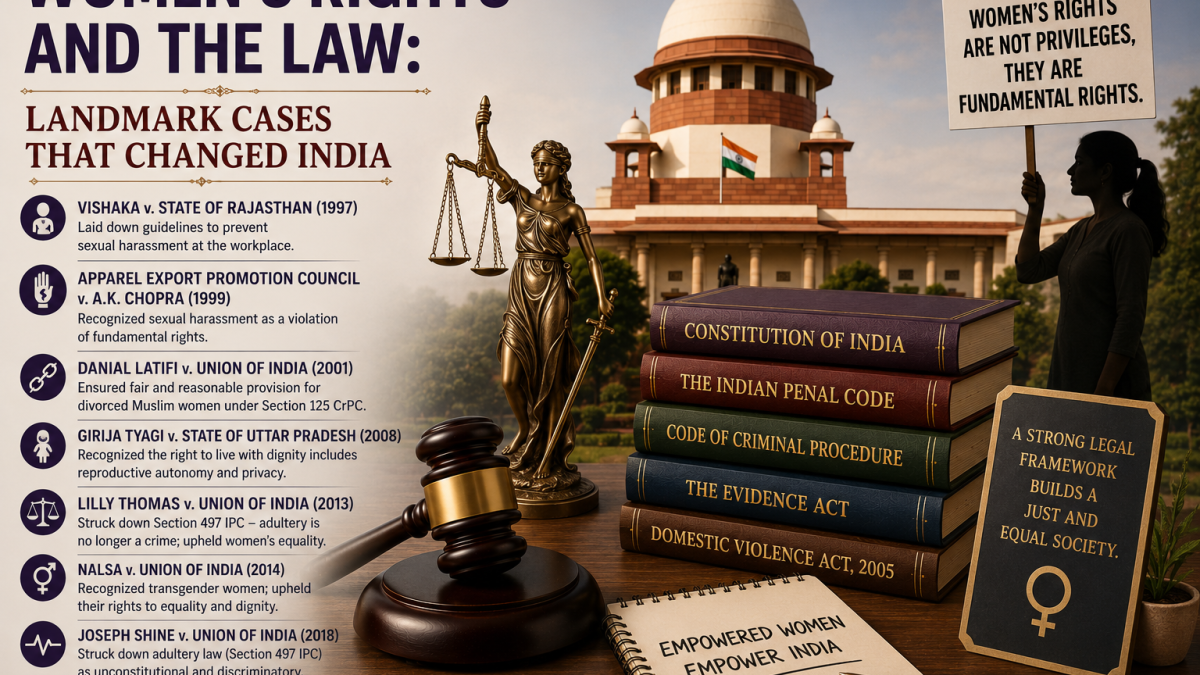
Sexual Harassment at the Workplace: Vishaka v. State of Rajasthan (1997)
The Supreme Court’s judgment in Vishaka v. State of Rajasthan is one of the most celebrated judicial contributions to the protection of women’s rights in India. The case arose from a gang rape of a social worker, Bhanwari Devi, who was trying to prevent a child marriage in Rajasthan. In the absence of domestic legislation on workplace sexual harassment, the Supreme Court laid down comprehensive guidelines binding on all employers under the name “Vishaka Guidelines.”
These guidelines defined sexual harassment, required employers to establish complaints committees, and mandated awareness programmes. The judgment drew upon international conventions, including the Convention on the Elimination of All Forms of Discrimination Against Women (CEDAW), to fill the legislative vacuum. The Vishaka judgment eventually led to the enactment of the Sexual Harassment of Women at Workplace (Prevention, Prohibition and Redressal) Act, 2013, which gave statutory force to the principles laid down by the Court.
Right to Matrimonial Home: Saroj Rani v. Sudarshan Kumar (1984)
The Supreme Court in Saroj Rani v. Sudarshan Kumar addressed the constitutionality of Section 9 of the Hindu Marriage Act, which provides for restitution of conjugal rights. While the Court upheld the provision, it emphasized that the concept of marriage must be understood in the context of the constitutional guarantee of equality and dignity. The judgment sparked significant debate about women’s bodily autonomy within marriage and whether the legal enforcement of cohabitation infringes upon personal liberty.
Property Rights of Women: Danamma @ Suman Surpur v. Amar (2018)
The Supreme Court in Danamma @ Suman Surpur v. Amar clarified the retroactive application of the Hindu Succession (Amendment) Act, 2005, which granted daughters equal coparcenary rights in ancestral property. The Court held that daughters who were born before the 2005 amendment also have equal rights as coparceners in ancestral property, overcoming earlier ambiguity on the retrospective application of the amendment. This judgment was a watershed moment for the property rights of millions of Hindu women across India.
Subsequently, in Vineeta Sharma v. Rakesh Sharma (2020), a three-judge bench of the Supreme Court conclusively settled the law on daughters’ coparcenary rights, holding that the right accrues to daughters by birth and is not dependent on whether the father was alive on or before the date of the 2005 amendment.
Triple Talaq: Shayara Bano v. Union of India (2017)
In one of the most debated judgments in recent times, the Supreme Court in Shayara Bano v. Union of India declared the practice of instantaneous triple talaq (talaq-e-biddat) unconstitutional by a 3:2 majority. The majority held that the practice was manifestly arbitrary and violated the fundamental right to equality guaranteed under Article 14. The judgment was hailed as a major step forward for Muslim women who were vulnerable to instant divorce without any procedural safeguards.
Following this judgment, the Parliament enacted the Muslim Women (Protection of Rights on Marriage) Act, 2019, which criminalized the pronouncement of instant triple talaq and provided for imprisonment of up to three years for the offending husband. The legislative response to the Supreme Court’s judgment was unprecedented in Indian family law and demonstrated the dynamic interplay between judicial pronouncements and legislative action in advancing gender justice.
Adultery: Joseph Shine v. Union of India (2018)
The Supreme Court in Joseph Shine v. Union of India unanimously struck down Section 497 of the Indian Penal Code, which criminalized adultery and treated married women as the property of their husbands. The Court held that the provision violated the fundamental rights of women to equality, dignity, and autonomy, as it treated women not as independent individuals but as chattels of their husbands. Chief Justice Dipak Misra observed that a law that treats women as second-class citizens and denies them agency over their own sexuality cannot withstand constitutional scrutiny.
Protection from Domestic Violence
The Supreme Court and various High Courts have played a crucial role in interpreting and expanding the scope of the Protection of Women from Domestic Violence Act, 2005. In Hiral P. Harsora v. Kusum Narottamdas Harsora (2016), the Supreme Court struck down the limitation in the Act that restricted the respondent in domestic violence complaints to only male individuals, holding that it discriminated against women who were victims of abuse by other women in the household.
Courts have also consistently held that the right to reside in the shared household under the Domestic Violence Act is a substantive right of an aggrieved woman and cannot be defeated by the technical ownership or tenancy of the property. These interpretations have significantly strengthened the practical protection available to women facing domestic violence.
Conclusion
The judicial journey towards gender justice in India has been marked by both significant achievements and ongoing challenges. Courts have time and again acted as agents of change, striking down discriminatory laws and expanding the scope of constitutional protections for women. However, the effective realization of women’s rights requires not only landmark judgments but also robust enforcement mechanisms, legal awareness, and a fundamental shift in social attitudes. As India continues to evolve as a constitutional democracy, the courts will remain indispensable partners in the pursuit of a more equal and just society for women.