Introduction
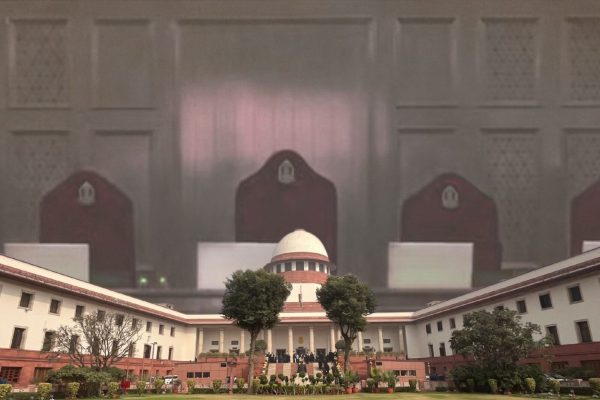
The Supreme Court of India stands as the ultimate guardian of the Constitution and the fundamental rights enshrined therein. Since its establishment in 1950, the Court has delivered numerous path-breaking judgments that have not only interpreted and expanded the scope of fundamental rights but have also shaped the socio-political and legal landscape of the nation. These judgments have often served as instruments of social transformation, upholding the dignity, liberty, and equality of every Indian citizen.
Part III of the Indian Constitution, which guarantees fundamental rights, has been the subject of extensive judicial interpretation. The Supreme Court has consistently adopted a purposive and expansive approach to these rights, ensuring that they remain living and dynamic guarantees rather than mere textual formalities. This article examines some of the most significant Supreme Court judgments on fundamental rights that have shaped Indian constitutional jurisprudence.
The Foundation: Kesavananda Bharati Case (1973)
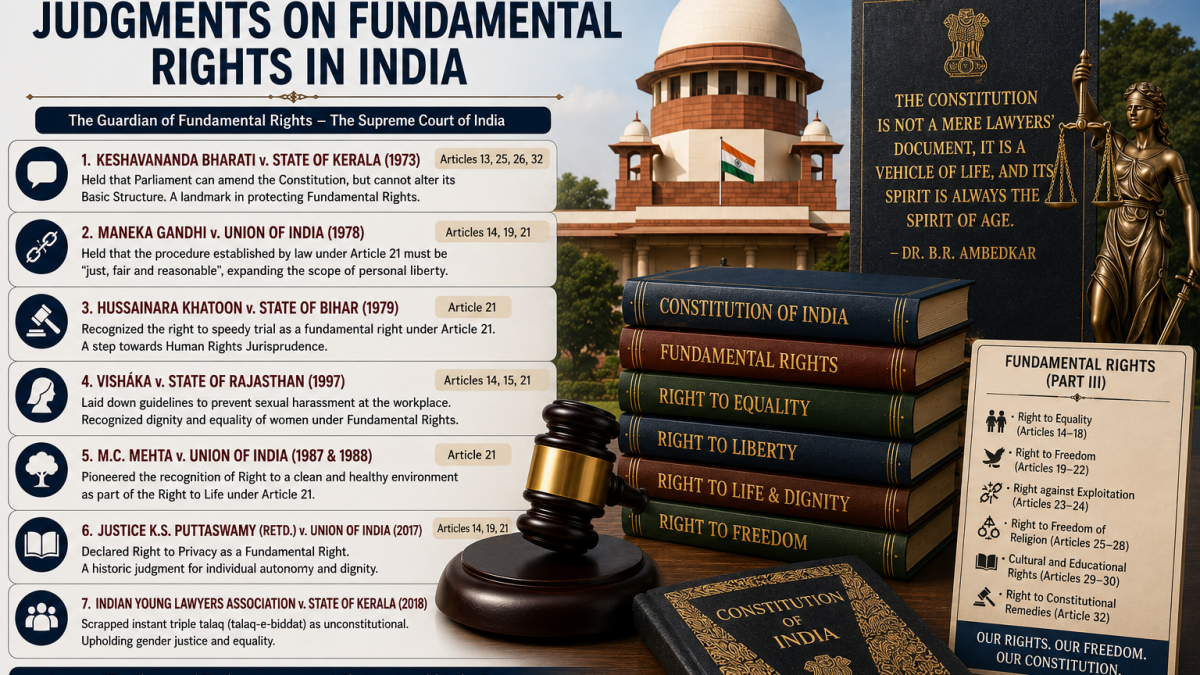
Perhaps the most consequential constitutional judgment in Indian legal history, Kesavananda Bharati v. State of Kerala established the doctrine of the Basic Structure of the Constitution. A 13-judge bench of the Supreme Court held by a 7:6 majority that while Parliament has the power to amend the Constitution under Article 368, it cannot alter or destroy its basic structure. This judgment has served as an inviolable check on parliamentary supremacy and has protected fundamental rights from legislative overreach.
The basic structure doctrine has since been invoked in numerous cases to strike down constitutional amendments that sought to curtail fundamental rights. The judgment established that rights such as equality, liberty, and the rule of law are not mere statutory privileges but form the unamendable core of the Indian constitutional order.
Right to Life and Personal Liberty: Maneka Gandhi v. Union of India (1978)
The Supreme Court’s judgment in Maneka Gandhi v. Union of India fundamentally transformed the interpretation of Article 21, which guarantees the right to life and personal liberty. The Court held that the procedure established by law for depriving a person of life or liberty must be fair, just, and reasonable, and not merely arbitrary or oppressive. Justice P.N. Bhagwati’s historic observation that Article 21 must be read with Articles 14 and 19 created an inseparable trinity of fundamental rights.
This judgment paved the way for the expansive interpretation of Article 21 that has since been read to include rights to privacy, livelihood, health, education, a clean environment, and many other social and economic entitlements. The Maneka Gandhi judgment marked the beginning of a new era of constitutional jurisprudence in India, where the Supreme Court assumed an activist role in expanding the horizon of fundamental rights.
Right to Equality: Indra Sawhney v. Union of India (1992)
The Mandal Commission judgment, as Indra Sawhney v. Union of India is popularly known, is one of the most significant pronouncements on the right to equality and reservations in India. A nine-judge bench of the Supreme Court upheld the government’s decision to implement 27% reservation for Other Backward Classes in central government services, while simultaneously imposing a ceiling of 50% on total reservations and excluding the creamy layer from the benefits of reservation.
The judgment interpreted Articles 14, 15, and 16 of the Constitution in the context of social and historical inequalities and clarified the constitutional boundaries of affirmative action. It recognized that true equality requires differential treatment for historically disadvantaged groups and affirmed the state’s power to identify and uplift backward classes through reservations.
Right to Privacy: Justice K.S. Puttaswamy v. Union of India (2017)
In a unanimous judgment by a nine-judge constitutional bench, the Supreme Court in Justice K.S. Puttaswamy v. Union of India declared privacy a fundamental right protected under Article 21 of the Constitution. The judgment overruled earlier decisions that had denied the status of a fundamental right to privacy and affirmed that the right to privacy encompasses informational privacy, bodily integrity, and the right to be left alone.
The Puttaswamy judgment has had far-reaching implications for data protection, surveillance, and individual liberty in the digital age. It has been invoked in subsequent cases to challenge the mandatory linking of Aadhaar with bank accounts and mobile phones, as well as in cases involving the rights of LGBTQ+ individuals. The judgment is widely regarded as one of the most sophisticated constitutional analyses in the history of the Supreme Court.
Decriminalization of Homosexuality: Navtej Singh Johar v. Union of India (2018)
Building on the foundation laid by the Puttaswamy judgment, the Supreme Court in Navtej Singh Johar v. Union of India unanimously struck down Section 377 of the Indian Penal Code insofar as it criminalized consensual sexual conduct between adults of the same sex. The Court held that the provision violated the fundamental rights of LGBTQ+ individuals to equality, dignity, privacy, and non-discrimination.
The judgment is a landmark in the protection of minority rights in India and represents the Supreme Court’s willingness to protect the rights of marginalized groups against majoritarian sentiment. The Court’s observation that constitutional morality must prevail over social morality has significant implications for the interpretation of fundamental rights in a diverse and pluralistic society.
Freedom of Speech and Expression
The Supreme Court has been a steadfast protector of the freedom of speech and expression guaranteed under Article 19(1)(a). In Shreya Singhal v. Union of India (2015), the Court struck down Section 66A of the Information Technology Act, which criminalized online speech that was grossly offensive or caused annoyance or inconvenience, as unconstitutionally vague and overbroad. The judgment was hailed as a major victory for online free speech in India.
Similarly, in S. Rangarajan v. P. Jagajivan Ram (1989), the Court affirmed that the freedom of speech and expression can only be restricted on the grounds expressly provided in Article 19(2) and that the test for imposing restrictions must be based on a clear and present danger to public order, security of the State, or other constitutionally recognized interests.
Right to Education: Unni Krishnan v. State of Andhra Pradesh (1993)
The Supreme Court in Unni Krishnan v. State of Andhra Pradesh recognized the right to education as a fundamental right flowing from Article 21, holding that every child has a fundamental right to free education up to the age of 14 years. This judgment was a significant step in the constitutional recognition of socio-economic rights as enforceable fundamental rights and paved the way for the insertion of Article 21A by the 86th Constitutional Amendment in 2002, which explicitly guarantees free and compulsory education to children between the ages of 6 and 14.
Conclusion
The Supreme Court of India’s jurisprudence on fundamental rights is a rich and evolving body of law that reflects the Court’s commitment to constitutional values of justice, liberty, equality, and fraternity. Through bold and innovative interpretations of constitutional provisions, the Court has expanded the ambit of fundamental rights to address the complex challenges of a modern democratic society. These landmark judgments continue to guide lower courts, influence legislative policy, and inspire citizens to assert their constitutional rights. The journey of fundamental rights in India is, in many ways, the story of the nation’s own democratic evolution.