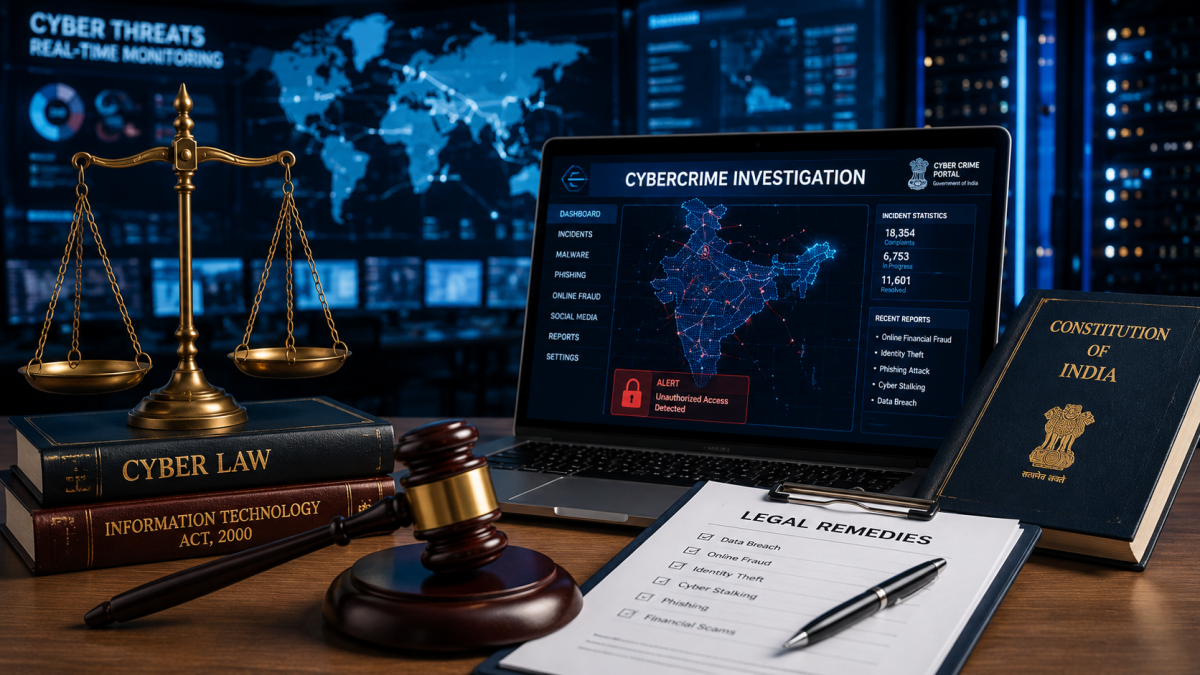
Legal Remedies, Reporting Mechanisms, and Emerging Challenges
Published On: 22 May 2026
Category: Cyber Law
Author: Priya Desai
Reading Time: 9 Minutes
Meta Title: Cybercrime in India: Legal Remedies and Reporting Mechanisms | JusticeOrder
Meta Description: Learn about India’s cybercrime laws, reporting mechanisms, investigation framework, and the legal remedies available to victims of online fraud, identity theft, and cyber offences.
Introduction
As India’s digital economy continues to grow, cybercrime has emerged as one of the most significant legal and enforcement challenges facing individuals, businesses, and government institutions. From financial fraud and phishing attacks to identity theft and ransomware incidents, cyber offences have become increasingly sophisticated and widespread.
The legal framework governing cybercrime in India is primarily derived from the Information Technology Act, 2000, supplemented by provisions of the Bharatiya Nyaya Sanhita, 2023 (BNS), procedural laws, and sector-specific regulations.
Understanding available legal remedies and reporting mechanisms is essential for both prevention and effective response.
What Constitutes Cybercrime?
Cybercrime refers to unlawful activities committed using computers, digital devices, networks, or the internet.
Common forms include:
- Online financial fraud
- Identity theft
- Phishing attacks
- Data theft
- Cyberstalking
- Online harassment
- Ransomware attacks
- Hacking and unauthorized access
- Impersonation using digital platforms
- Social media fraud
Many cyber offences target individuals, while others focus on businesses, financial institutions, or critical infrastructure.
The Information Technology Act, 2000
The Information Technology Act remains India’s primary cyber law legislation.
Several provisions deal directly with cyber offences.
Section 43
Provides remedies for unauthorized access, downloading, copying data, introducing malware, or disrupting computer systems.
Section 66
Prescribes penalties for dishonest or fraudulent acts involving computer resources.
Section 66C
Deals with identity theft involving passwords, digital signatures, and electronic credentials.
Section 66D
Addresses cheating through personation using computer resources.
This provision is frequently invoked in online fraud and scam-related cases.
Section 67
Applies to the publication or transmission of obscene material in electronic form.
Cybercrime and the Bharatiya Nyaya Sanhita, 2023
While the Information Technology Act remains the principal legislation, many cyber offences also attract provisions under the Bharatiya Nyaya Sanhita.
Depending on the nature of the offence, authorities may invoke provisions relating to:
- Cheating
- Criminal breach of trust
- Forgery
- Extortion
- Criminal intimidation
- Defamation
The combination of cyber-specific and general criminal provisions enables broader enforcement action.
Reporting Cybercrime in India
Victims can report cyber offences through multiple channels.
National Cyber Crime Reporting Portal
The Government of India operates the National Cyber Crime Reporting Portal:
The portal allows individuals to report:
- Financial fraud
- Online harassment
- Social media abuse
- Identity theft
- Child exploitation-related offences
- Other cyber incidents
Cyber Crime Helpline 1930
Victims of online financial fraud can immediately contact 1930, the national cybercrime helpline.
Prompt reporting may improve the chances of freezing fraudulent transactions before funds are withdrawn.
Local Police and Cyber Cells
Cybercrime complaints may also be lodged with:
- Local police stations
- State cybercrime units
- Specialized cyber police stations
The Supreme Court has repeatedly emphasized that law enforcement authorities must register cognizable offences when required by law.
Challenges in Cybercrime Investigation
Despite improvements in digital policing, several challenges remain.
Cross-Border Jurisdiction
Cyber offenders often operate from multiple jurisdictions, making investigation and prosecution more complex.
Anonymity
Virtual private networks, encrypted communication tools, and anonymous accounts can complicate identification efforts.
Rapid Technological Evolution
Technology often evolves faster than regulatory and enforcement frameworks.
Investigators must continuously adapt to new threats involving artificial intelligence, cryptocurrency, and sophisticated fraud techniques.
Emerging Cyber Risks
Artificial Intelligence-Based Fraud
Generative AI technologies have increased concerns regarding:
- Deepfake videos
- Voice cloning scams
- Synthetic identities
- Automated phishing campaigns
These developments present novel legal and evidentiary challenges.
Cryptocurrency-Related Fraud
Digital asset fraud continues to attract regulatory attention.
Investigators increasingly encounter cases involving:
- Fake investment platforms
- Wallet theft
- Fraudulent token offerings
- Ponzi schemes disguised as crypto investments
Data Breaches
Large-scale data breaches raise concerns regarding privacy, cybersecurity compliance, and corporate accountability.
Organizations handling personal information face growing scrutiny regarding data protection practices.
Preventive Measures
Individuals can reduce cyber risks by:
- Using strong passwords
- Enabling multi-factor authentication
- Verifying financial transactions
- Avoiding suspicious links
- Regularly updating devices
- Monitoring financial accounts
- Exercising caution when sharing personal information online
Businesses should implement cybersecurity policies, employee training programs, and incident response frameworks.
Conclusion
Cybercrime is no longer a niche concern affecting only technology companies. It has become a widespread threat impacting individuals, businesses, and public institutions alike.
India’s legal framework provides several remedies for victims through the Information Technology Act, criminal law provisions, and dedicated reporting mechanisms. However, as technology continues to evolve, legal institutions, regulators, and enforcement agencies will need to adapt continuously to emerging digital threats.
For citizens, awareness and prompt reporting remain among the most effective tools in combating cybercrime.
Sources
- Information Technology Act, 2000.
- Bharatiya Nyaya Sanhita, 2023.
- National Cyber Crime Reporting Portal (cybercrime.gov.in).
- Ministry of Electronics and Information Technology (MeitY).
- Indian Computer Emergency Response Team (CERT-In).
Disclaimer: This article is intended solely for informational purposes and does not constitute legal advice.